
Leveraging Zee's user base to reduce CAC
Process and Structure in Ambiguity
Role: Senior Product Designer
Working with: Sharad Singh (Associate Product Designer)
Charter: Acquisition
Problem:
-
The cost of acquiring new users was exorbitant hovering around Rs560 fluctuating with marketing spend of the month, at an average revenue per user was at Rs699
-
Lacked a clear PRD
-
Stakeholders had conflicting views on timelines, rewards, and feasibility
Impact:
-
Designed and launched the first referral program for an OTT.
-
Leveraged our user base to reduce the acquisition cost.
-
Developed a design brief format that became standard across our design team.

Process:
Referral was chosen as a growth lever by Product to reduce dependence on paid acquisition. The project was being researched by a junior designer when I joined the charter, who had completed the competitor analysis for various referral programs. My responsibility was to aid in launching the feature, with a desirable experience.
The PM wanted to fast track the project and proposed a 7 day sprint to launch the feature. The ask was bold, but I didn’t want to shoot down the idea this early into the charter. I called for a white boarding session to map out the “happy flow” the PM had in mind, to understand the scope of work. I invited the front end engineering leads as well as the backend lead to align on the flow and comment on the timelines. The backend team asked for a 6 months to build the referral engine where the rewards can be stored and redeemed by the user. We jointly agreed to a new timeline of 6 months until launch.
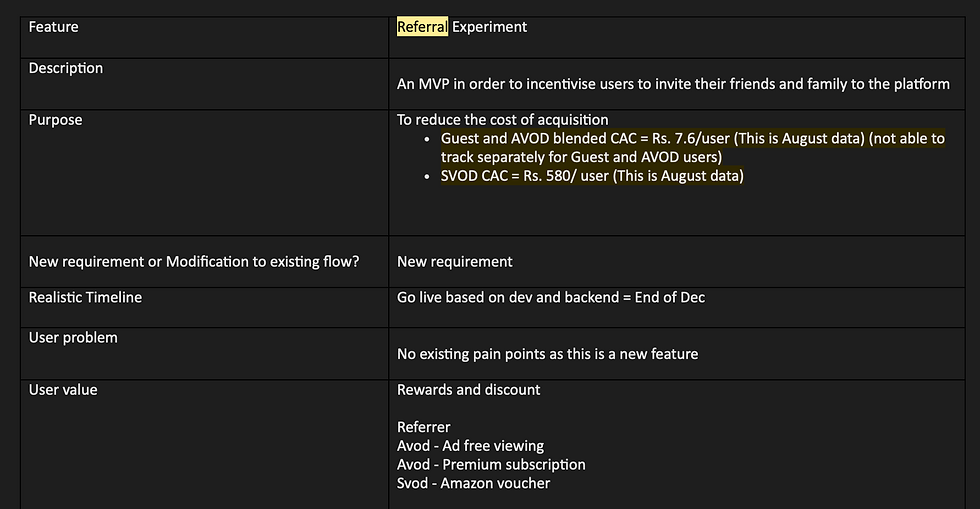
As the requirement wasn’t clear and repeated followups on PRD wasn’t fruitful, I chose to share a design brief that encapsulated all the information I needed as a designer, where I articulated the assumptions I was making and the information that was not clear to me. This was shared with the PM and the relevant stakeholders requesting clarity. This later developed into a formal Design brief document that was adopted as a org wide practice by all the designers.
A key component of the brief was the success metric which was defined as reduction in CACQ by 50% it was clear that this was an audacious goal to have, and one everyone wanted to achieve differently. The PM wanted to create a contest with an iphone as a reward, awarding it to the person with the most amount of referrals at the end of a month. Business wanted to use Amazon vouchers, as a reward to test the mechanism and control the denominations. My proposal was to split the Rs250 between the two parties, to incentivise action. I proposed a Rs 200 discount to the users joining via a referral link, and a month of premium membership free for users who make the referral. the current cost of subscription was at Rs599/year bringing its per month cost close to Rs58 and the total CAC to 258rs.

The product, development and design team had different ideas on how the referral model should work. I facilitated cross functional alignment by conducting a workshop, to ideate on 2 key screens in the flow by means of low fidelity wireframes. - Referral landing screen - Referee landing screen Having all the stakeholders in one room allowed us to have quick reviews on feasibility from a development POV, Viability of the timeline as well as the most desirable experiences.


We built a wireframe prototype of the same and circulated it internally to gain insight on the experience, and buy in on some of the assumptions we were working with such as the reward mechanism etc.
Feedback suggested removing the onboarding tutorial entirely to reduce friction. The team’s concern was rooted in the 'more clicks lead to more drop-off' principle, I believed that the tutorial was vital for user comprehension of the referral program. To bridge this gap, I redesigned the interaction into an automated, story-style experience that required zero clicks, while allowing users to skip the tutorial when necessary. Leading users seamlessly to the landing page. By prototyping this 'passive' education model, the team's concerns regarding drop-offs while retaining the necessary context was addressed . This compromise was so well-received that it evolved into a plan to use celebrity-led video walkthroughs rather than static text.

We further tested this version with a set of 12 users with help of our in house research team. feedback indicated users wanted wanted to know what content the platform had to offer before making a purchase decision. This took us back to the drawing board the risk of allowing sampling with the current methods lay in the users forgetting about the referral flow. I redesigned the referee landing page to include more content and allow for sampling on the same page without taking them to the homepage, thus preserving the referral context.


We designed supporting touch points (completion, notifications, redemption) to ensure continuity across the referral flow and got the screens ready for development using the design system.
The CEO asked for an expedition in timelines, 4 month development was crunched to launch in 15 days, the focus shifted from getting the experience right to getting the feature to production. It was clear that the development team could only develop a portion of the flow. Parts of the flow that were being dropped were
-
Notification
-
Onboarding
-
Referee landing page
-
Payment completion page
-
Reward mechanism I made a case for the trade offs,
-
Notification- first touch point and a delight feature would impact on how the brand was viewed
-
Onboarding - removing this could lead to lower engagement and also misunderstanding of how the program functions. Risk of more complaints
-
Referee landing page - KEY RISK! launching without this page could sabotage the entire flow. could mean, people receiving the link may not join the platform or misunderstand this as a scam.
-
Payment completion page - A good to have feature, ties up the feature overall.
-
Reward mechanism - KEY RISK! Could lead to lack of participation overall and not meeting the success metic outlined.
While the roadmap was owned by the product and business team. When the PM decided to go ahead inspite the concerns I decided to escalated the matter to the managers and the Head of design. The consensus reached was to go live with what we have right now. and backfill the rest as design backlog. Changes were required on the existing referral screen in order to remove the Onboarding components that linked to the referral landing page. The feature was launched as a partial experience. and had an underwhelming response.

I requested the research team to conducted another user test on the partial flow as well as an in-depth foundational research to understand consumer psychology around recommending content and OTT, This research was conducted with 23 participants but the research team. Due to organisational changes I needed to hand over the project to a fellow designer and move to a different charter.
When the Research findings came about we learnt how “Sharing” was a key component in referral and how recommending content was an underlying need the users had. I redesigned the referral page keeping in mind the insights and handed to the acquisition to develop further.
